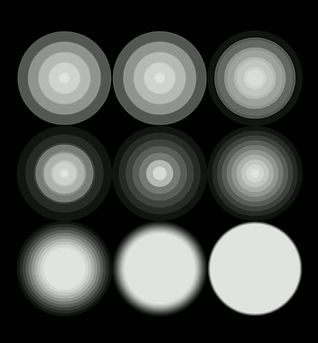
"Geometric shapes have the ability to signify the most unfathomable idea of the macrocosm. In Betsy Kenyon’s photograms, a circle becomes a portal, and the layering of squares leads you through parallel dimensions... While not overtly autobiographical of the artist, these images delve into the larger, shared story of humankind and our place in the universe."

Grey Matter is an ongoing project where I sculpt light and time recording momentary gestures onto silver-gelatin photographic paper in a chemical darkroom. Multiple series make up Grey Matter, yet all the images are composed individually in unique, split-second, exposure/gestures. These incremental advances become differences in tonal value and ultimately differences in a perceived visual space. These works challenge distinctions between 2-dimensional and 3-dimensional experiences and capture normally imperceptible time events. Blurring established lines between drawing, painting, photography and sculpture, I’m exploring intently darkroom technique as material.


CONTACT
CONTACT SERIES – 20” x 24”
Unique chemical darkroom prints on Fiber-based Silver Gelatin paper


Process
LOGOS


LOGOS SERIES – 11” x 14”
Unique chemical darkroom prints on Fiber-based Silver Gelatin paper
FORM CLOUDS


FORM CLOUDS SERIES - 24” x 36”
Unique chemical darkroom prints on Fiber-based Silver Gelatin paper
LESS THAN A SECOND


LESS THAN A SECOND SERIES – Various sizes
Unique chemical darkroom prints on Fiber-based Silver Gelatin paper

How does one quantify or describe the experience of nonrepresentational, nonfigurative photography consisting only of gradient forms and geometric patterns – the kind of abstraction afforded traditionally to painters and sculptors? Grey Matter, Betsy Kenyon’s ongoing exploration of both traditional and invented darkroom techniques engenders the experience of form itself. The work plays with dimension, depth, and perspective and suggests values of minimalism and psychedelia, free of literal subject matter, narrative, humanism, or statement. Kenyon deftly challenges the boundaries of photography, offers a new vision for the medium, and gifts us a greyscale language that is simple as it is profound.

Written for the exhibition at UNC Chapel Hill by Max Neely-Cohen The hardest thing one can do on a flat surface is represent light with any authenticity. Not just light that is ambient, that is merely a medium for other objects, but true light, emanating outward, radiating with a brightness that can pulse, rebound, and fade. Betsy Kenyon can make paper scream with photons. She can put a fusion reaction onto a millimeter plane. She does this by using light itself as a medium. A source. No lens needed, just alternating the gift and denial of illumination at the right moments. Every burn can be controlled. We can paint with light it turns out. Wield it at a target. Planets and doors, logos and swarms, the frozen chaos of particle collision at the smallest possible level. Shapes in mathematical transformations so perfect they belong in geometry textbooks. Film backdrops in stasis. Betsy once told me that she wanted her images to be verbs. As much as I want to assign nouns to them—gravity, cosmos, shadows—she is right, they are verbs, best verbalized as actions. They push. Pull. Rotate. Cycle. Drop. Blur. Filter. Contract. Expand. Crush. Some of them run. Some of them crawl. Some of them even disappear. A magic trick. Frozen. When rendered in digital space these forms reveal their tricks and secrets. How a simple shape set into motion can blossom into a complex lattice, a structure worthy of a sigil or temple. How long it takes our eyes to notice a blurring edge, the slight shift of a gradient. How that can become layers of a staircase, an invitation to plunge or accept an outstretched hand. It almost doesn’t matter if the images are moving or not. The animations can be read as still, the photograms rendered as moving. Don’t fall in.